KEA Kalyana Karnataka Group C Syllabus 2026: Exam Pattern & Post Details
Karnataka Examination Authority has released the Paper-2 syllabus for Kalyana Karnataka Group C technical posts. Check the detailed exam pattern and topic-wise breakdown for Electrician and Water Supply Operator vacancies.
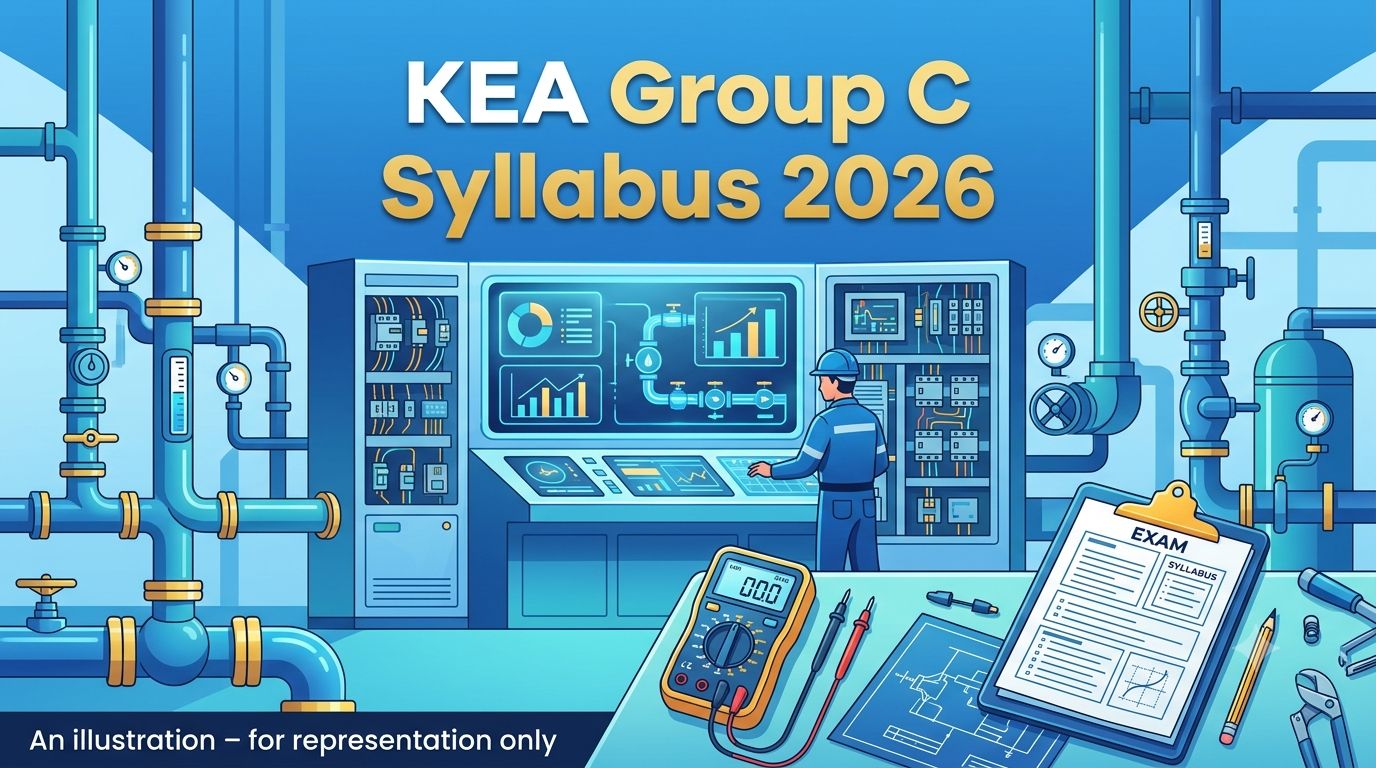
The Karnataka Examination Authority (KEA) has officially issued the Paper-2 Specific Subject syllabus for Group C technical posts in the Kalyana Karnataka cadre, including Electrician Grade-1, Electrician Grade-2, Water Supply Operator, and Assistant Water Supply Operator.
Overview of KEA Kalyana Karnataka Group C Exam
| Information Attribute | Details |
|---|---|
| Recruitment Authority | Karnataka Examination Authority (KEA) |
| Region / Cadre | Kalyana Karnataka (KK Cadre) |
| Cadre Classification | Group C Technical Posts |
| Designations Covered | Electrician Grade-1, Electrician Grade-2, Water Supply Operator, Assistant Water Supply Operator |
| Exam Paper Focus | Paper-2 (Specific Paper / ನಿರ್ದಿಷ್ಟ ಪತ್ರಿಕೆ) |
| Question Format | Objective Type Multiple Choice Questions (MCQs) |
| Official Portal | cetonline.karnataka.gov.in/kea |
KEA Group C Exam Scheme (Paper-2 Specific Subject)
| Paper | Focus Area | Total Marks | Duration | Question Format |
|---|---|---|---|---|
| Paper-1 | General Knowledge, General Studies, Kannada & English Proficiency | 100 Marks | 2 Hours | Multiple Choice Questions |
| Paper-2 | Specific Technical Subject (Job-Role Oriented Syllabus) | 100 Marks | 2 Hours | Multiple Choice Questions |
Detailed Syllabus: Electrician Grade-1 & Electrician Grade-2 (Annexure-1)
| Unit Number | Subject Area | Detailed Topics Covered |
|---|---|---|
| Unit I | Basic Electrical Engineering & Electrical Calculations | Fundamentals of electricity: electric current, voltage, resistance, power, and energy; Units of electrical quantities; Ohm’s Law and its practical applications; Series, parallel, and series-parallel circuits; Kirchhoff’s Laws and elementary applications; Electrical work, power, and energy calculations; AC and DC fundamentals; Frequency, cycle, time period, phase, and waveform; Single-phase and three-phase AC systems; Star and Delta connections (basic concepts); Power factor and significance; Basic electrical load calculations. |
| Unit II | Electrical Safety, Tools, Materials & Workshop Practice | Electrical safety rules and precautions; Electrical hazards and prevention of accidents; Personal Protective Equipment (PPE); Electric shock rescue protocols and first aid; Electrical fires and types of fire extinguishers; Safe isolation of electrical circuits; Electrician hand tools and power tools; Care and maintenance of electrical tools; Conductors, insulators, and semiconductors; Electrical materials and characteristics; Soldering, crimping, cable joints, and terminations. |
| Unit III | Electrical Wiring, Cables & Installations | Types of electrical wires and cables; Cable size, insulation, current-carrying capacity, and voltage rating; Cable joints, lugs, glands, and terminations; Domestic, commercial, and industrial wiring; Conduit wiring and alternative wiring systems; Switches, sockets, and wiring accessories; Distribution boards; Single-phase and three-phase wiring setups; Staircase, corridor, and godown wiring; Wiring of lamps, fans, and appliances; Identification and rectification of wiring faults; Load calculation and cable selection; Electrical installations in municipal and public buildings. |
| Unit IV | Electrical Measuring Instruments, Testing & Fault Finding | Working and usage of ammeter, voltmeter, wattmeter, and energy meter; Multimeter and clamp meter operations; Insulation resistance tester (Megger); Earth resistance tester; Measurement of voltage, current, resistance, power, and energy; Continuity and insulation resistance testing; Testing of electrical wiring and installations; Detection of open circuit, short circuit, and earth leakage; Identification of common electrical faults; Basic systematic troubleshooting methods. |
| Unit V | Electrical Machines (Transformers, Motors & Generators) | Transformers: Principle, working, 1-phase and 3-phase transformers, transformation ratio, losses, efficiency, and basic maintenance.
Motors: Operating principles of electric motors, AC/DC motor concepts, 1-phase and 3-phase induction motors (squirrel-cage and slip-ring), motor nameplate particulars, Star-Delta and DOL starters, reversal of direction, common motor faults, and maintenance.
**Please share or paste the blog text you would like formatted. Once you paste the content, I will remove all citation markers like ``, structure the information into clean Markdown tables, and format any code blocks inside Markdown fences.
Important Official Links
| Link Description | Action / Direct URL |
|---|---|
| KEA Kalyana Karnataka Group C Syllabus 2026 | Click Here |
| KEA Official Portal | Click Here |
Get more jobs like this
🔔 Join our channels for instant undefined job alerts.
Free · No spam · Leave anytime